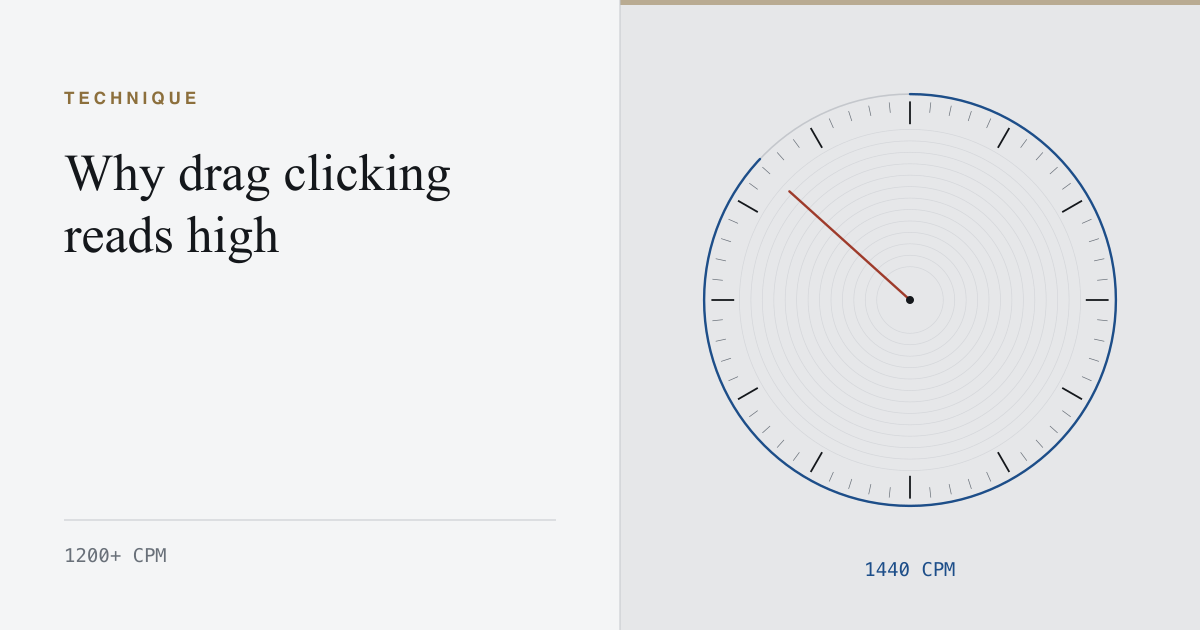
Drag clicking is the technique that breaks every scale. Drag a fingertip across the button with enough friction and the switch chatters — one motion produces a burst of contact closures, and the browser reports every one of them as a click.
Readings of 1,200 CPM and above are routine. Some mice produce 3,000.
What the number is measuring
Nothing about your hand. The rate is set by three properties of the equipment:
- Switch bounce characteristics — how readily the contacts chatter.
- Debounce window — how much of that chatter the mouse’s controller filters out before reporting anything.
- Surface friction — how the button’s coating grips a dry fingertip.
Change the mouse and the same motion produces a different number. That is the definition of an instrument artefact rather than a measurement.
Why the chronometer still counts them
Because the alternative is worse. Filtering presses that arrive “too fast” would mean choosing a threshold, and any threshold discards real presses from a genuinely fast butterfly run. The chronometer counts what the browser dispatches and is explicit about what that means: the top calibration band is labelled instrument-limited, not by any human quality, precisely because a reading up there is a property of the mouse.
The practical position
Most competitive servers ban drag clicking, and anti-cheat plugins flag sustained rates above roughly 1,200 CPM because no hand produces that on one button. It also wears switches out fast — the chatter that makes it work is the contacts degrading in real time.
If you want to see it, run the one-second interval and enjoy the number. Do not compare it against anything, and do not expect the mouse to survive a habit of it.